It turns out that those teasing thundershowers last Friday were the beginning of some more substantial rains. It has rained hard at times over the last few days and nights (though not as steadily as before). Consequently, many people are breathing sighs of relief.
Before now, I've never really been in a place where the threat of drought has had such severe implications. Droughts and famines are among those "tragedies" that we hear about from afar, but rarely experience for ourselves. By the time agricultural calamities reach Canadian grocery stores, the effects show up as temporarily higher prices or a few days where we can't buy grapefruit.
Here, lack of rain means that the main staples fail and people truly go hungry. Food for thought...
Monday, February 28, 2011

Friday, February 25, 2011
Weather worries
It's now been over three weeks since Mazabuka has seen any rain. The situation is not yet a real problem, but everyone is becoming increasingly worried about the weather. The maize crops that sprouted so eagerly in December and January need some more water to finish maturing. Some of the plants are already starting to go yellow.
Today, we've had a few very light thunder showers which haven't done much but dampen the leaves and cool the air. A colleague said, "It's as if the rain is joking with us." Another colleague said a few days ago, "It looks like we're going from bumper harvest (2010) to hunger." It's a long way to the next rainy season next November if this is it!
I sincerely hope we get some rain soon!!
Today, we've had a few very light thunder showers which haven't done much but dampen the leaves and cool the air. A colleague said, "It's as if the rain is joking with us." Another colleague said a few days ago, "It looks like we're going from bumper harvest (2010) to hunger." It's a long way to the next rainy season next November if this is it!
I sincerely hope we get some rain soon!!
Tuesday, February 15, 2011
The Case for Planning in Mazabuka
The following is a second article for the Mazabuka Times on the IDP:
***
***
In the January issue of the Mazabuka Times, we reported on the walking tours that were held with each of the Residential Development Committees (RDC) and Market Committees in the urban area of Mazabuka. The walking tours were popular among committee members, and they provided important insights into how residents live, work and move within their community. These “universal priorities” were: roads and drainage, markets, water service and waste management.
A follow up meeting was held with the RDCs on December 16, 2010 to formulate actions regarding the universal priorities. The discussion was intense and productive; the results of this meeting will be key in developing the policies and strategies to include in the final Integrated Development Plan for Mazabuka.
While stakeholders need to work towards improvements on each of these priorities, there are a number of higher-level, strategic issues that need attention for the IDP to succeed over its ten-year planning horizon. The purpose of this article is to highlight a few of these issues:
Keeping pace with population growth and service demands
Mazabuka is a thriving and growing community. In the previous Census (2000), the population of Mazabuka district was estimated at about 240,000 people, with over 80,000 people residing in the built-up urban area of the community. Annual population growth at that time was estimated in the range of 4%. However, a more recent estimate stated that the population was 280,000 in the year 2008. The change between 2000 and 2008 implies that the population might only have grown at an average of 2% per year in that time.
If the population of Mazabuka continues to expand at a rate of 2% per year, the population of Mazabuka district will reach over 360,000 by the year 2021, with more than 125,000 people living in the urban area. However, if population growth accelerates to 4% per year, the overall results will be far more dramatic. Under the second scenario, the district population would approach 550,000 with nearly 200,000 people living in town.
Population projections can never fully capture what will happen in the future, mainly because we can never “know” the future. The importance of projections is that they can guide decision makers as they plan for future housing developments, new and upgraded infrastructure and expansion of community services. Population projections require regular monitoring to ensure that development keeps pace with the “new arrivals”, which consist of newborn babies or migrants from other parts of Zambia.
Economic opportunity and secure livelihoods
As the local population continues to grow, it is essential to create and foster the conditions which will provide opportunities for women, men and youth to create secure livelihoods for themselves. Secure livelihoods can mean many things but according to Voluntary Services Overseas (VSO), “A secure livelihood means having access to the income and resources necessary to meet basic needs and survive shocks. It also means having more control over how [one's] living is made.”
The concept of secure livelihoods is central to the work that VSO and other organizations are doing in Zambia, and is fundamental to the practice of town planning. Vibrant and healthy communities depend on the success of local business ventures which are supported by a qualified and adequately paid workforce. Mazabuka is fortunate to host some major employers such as Zambia Sugar, Albidon Mine and several commercial farms, which provide jobs to many. However, it is also important to remember that the community survey for the IDP, which was completed in 2008, revealed that nearly 30% of the respondents are self-employed (e.g. operating a market stall, consulting, running a restaurant). A further 34% of survey respondents said that they are unemployed, which is a rather alarming figure. Mazabuka's future prosperity will therefore depend on creating economic opportunities to reduce such high rates of unemployment.
Protecting the environment
It is often easy to ignore the fact that humans are as much a part of the environment as are the trees, grass, birds and insects that surround us. But we can only ignore this fact at our own peril.
Town planning has much to do with environmental protection. For instance, it is generally good practice to set developments well back (e.g. 30 metres) from the high water mark of streams and rivers to avoid seasonal flooding to homes. Setting development back from the water's edge also benefits the stream, since pollutants from everyday human activities (e.g. using the toilet, washing laundry, disposing garbage) can be released into the water. These pollutants change the chemistry of the water, which can harm aquatic plants and animals. Since many among us eat fish and take water from the Kafue River, these pollutants can eventually harm us too!
Another example is that as we continue to buy manufactured goods, plastic-based packaging such as bags, bottles and wrapping makes its way into the community. Usually, these packages are designed to be strong and durable, which is great for transporting the manufactured item over a long distance. The downside is that these products don't easily break down once they've been used and later become waste. In Mazabuka, where many households either burn or bury their wastes in the yard, it means that we risk exposing ourselves directly to the chemicals that are released into the air, water and land. For these reasons, the Council is already working on new programs to collect waste from town, after which it can be dumped in a safe and properly designed waste disposal site.
Conclusion
Without doubt, town planning is an exciting and rewarding profession. However, it is no small challenge to integrate the needs of residents into one plan which addresses so many themes! There are many more to include in the eventual plan – the ones mentioned here are but a few issues to think about when planning the future growth and development of Mazabuka.
Tuesday, February 1, 2011
The harvests continue
As I hear of friends and family shivering in the -33C weather back in Ottawa/Toronto, I can't help but think how different my February looks.
Case in point: this evening as I approached my front gate, I found a small gaggle of children brazenly munching on the ripening guavas from the tree outside our wall fence. I'm not quite sure what the law says about trees in the boulevard, but Rob and I do feel some sense of ownership over the guava tree... and its fruit!
I wanted a few of the guavas too - just to try. So at my signal, the kids clambered back up in the branches and started pulling off fruit and throwing it down. They pulled at everything so I said, "Stop taking the green ones! Just the yellow ones!" Their reply was a bright and typically childlike, "Yes!" It was obvious that they didn't understand me very well. Eventually I asked them to come down and tried to explain that I didn't want them coming back to take ALL the fruit. I don't mind the kids taking some of them, but naturally we want a few (preferably ripe ones) to enjoy too!
Sadly, the mango season ended a few weeks ago. While we had far too many mangoes on the trees for our modest household to consume, I have a strong suspicion that the kids got into our compound and pilfered a few. There were so many and then suddenly very few. Where could they all have gone? I figure some might even have been sold in the market.
I'm actually rather amused about the situation. And on the upside, if we contributed some vitamins and income to some local kids, all the better!
Case in point: this evening as I approached my front gate, I found a small gaggle of children brazenly munching on the ripening guavas from the tree outside our wall fence. I'm not quite sure what the law says about trees in the boulevard, but Rob and I do feel some sense of ownership over the guava tree... and its fruit!
I wanted a few of the guavas too - just to try. So at my signal, the kids clambered back up in the branches and started pulling off fruit and throwing it down. They pulled at everything so I said, "Stop taking the green ones! Just the yellow ones!" Their reply was a bright and typically childlike, "Yes!" It was obvious that they didn't understand me very well. Eventually I asked them to come down and tried to explain that I didn't want them coming back to take ALL the fruit. I don't mind the kids taking some of them, but naturally we want a few (preferably ripe ones) to enjoy too!
Sadly, the mango season ended a few weeks ago. While we had far too many mangoes on the trees for our modest household to consume, I have a strong suspicion that the kids got into our compound and pilfered a few. There were so many and then suddenly very few. Where could they all have gone? I figure some might even have been sold in the market.
I'm actually rather amused about the situation. And on the upside, if we contributed some vitamins and income to some local kids, all the better!
Saturday, January 15, 2011
D.I.Y. Utilities Inc.
This morning, Rob and I woke up to find both the water and the power off. While it's a bit of overkill to get a generator, it's certainly no problem to harness the rains that so amply pour out of the sky.
Within a few minutes, I had three large buckets of water with which to do some dishwashing, toilet flushing, etc. If the situation persists for long, I'll pour the water through the filter and add some chlorine so that we have drinking water too. After all, the sky is where our drinking water comes from, isn't it?
 |
| The rainwater harvesting operation. |
 |
| The fruits of my industry. |
Wednesday, January 12, 2011
Rainy season
This week, I finally received a Christmas card from my mother in which she asked whether the initial rains had been temporary. No, indeed they are not temporary or light by any means. I thought I'd show a few photos to highlight what is meant by “rainy season”.
 |
| If one didn't know that this was my street, they might mistake it for the Zambezi River. |
 |
| The view from the office breezeway during one of the storms. |
Monday, January 10, 2011
Freedom 55 Retirement
For Councils in Zambia, the mandatory retirement age is an alarmingly young 55 years old. However, in a country where overall life expectancy is only 45, it is undoubtedly an accomplishment to reach 55. This contrasts starkly with the Canadian dream of retiring under the “Freedom 55” plan; it is clearly not the same situation here.
This past Friday, on my first day back at work, the Council held a retirement party to honour the four individuals that are departing to enjoy their “golden years”. My sense however, is that retirement at 55 can be a very uncertain event for those who are still able-bodied and of sound mind. Financially, retirement can also be an uncertain time for Zambians. With Council resources stretched as thin as they are, it is no secret that the Council struggles to pay the full lump sum retirement benefit that they pledge to their retiring employees.
Difficulties and uncertainties aside, the party was a fun time for everyone from directors to street sweepers to get together, dance and enjoy some laughs. I hadn't even expected to go to the party, but was asked to give the closing remarks on the fly. I kept my speech short and positive, and ended with a prayer-song written by my friend, singer-songwriter Pat Mayberry from Ottawa:
When you go from this place, be true.May the blessing of life find you.May the winds of the Spirit guide you,Across the ocean of all your days.May the seeds of your love, your life, adorn the way.
It took some courage to sing solo a capella, but the song was well-received. Many thanks to Pat for your inspiring words and music!


Sunday, January 9, 2011
Matebeto
Last night, my good friends Victoria and Lweendo prepared and hosted a group of us for a traditional Bemba dinner. I learned this week that the word for a buffet in the Bemba language is “matebeto”. All the dishes were quite tasty, though it took a leap of faith to try fried caterpillars for the first time. My favourite foods were the pumpkin leaves, fresh kapenta (2-inch long fish), beans and okra. It was a fun evening out with friends.
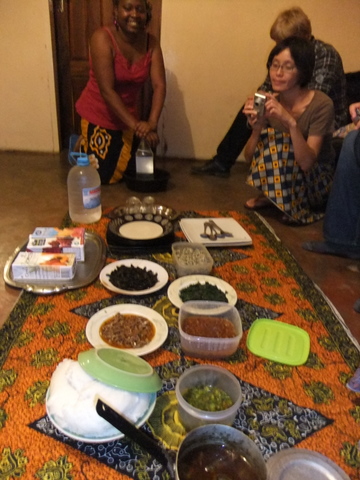 |
| The justifiably proud hostess Victoria presenting her matebeto! |
 | |
| A little bit of everything. Naturally, no Zambian meal would be complete without a large lump of nshima to use as an utensil. Clockwise from the nshima: liver, okra, beans, kapenta, fried caterpillars, pumpkin leaves and spinach with pounded groundnuts. |
Saturday, January 8, 2011
Extension
Though news has been getting around, I thought I'd take the opportunity to officially let everyone know that I'm going to be staying in Zambia a little longer than originally anticipated. My initial placement was designed for six months from July 15, 2010 to January 15, 2011 (yes, next week!), but to ensure that we get a bit more done, I've been asked to stay a few months more.
Consequently, I'll be working in Mazabuka until April 21, 2011, after which I'll travel a bit and then return home on May 15, 2011.
Incidentally, if any Canadian friends or family members would like to visit me in these next few months, let me know soon so we can arrange something before it's too late!
Subscribe to:
Posts (Atom)